Regaldi Quarry 0.1
REGALDI  ·  QUARRY 0.1  ·  FLORIDA  ·  LAND INTELLIGENCE

Florida property and auction research with sources.

The state's land auctions, read at a desk.

Quarry is a desk tool for Florida distressed property. Every cycle, close to a thousand parcels sell at tax-deed and foreclosure auctions across forty counties, on as many separate sites, each one a small research project. Quarry gathers them into one table, links lots to parcel records where a match is available, lays the state's risk and context over the whole map, runs the money case, and ranks what is worth a closer look. The aim is plain: find the few worth pursuing before the people still working county by county.

BY THE ORDER · FLORIDA A parcel brief or a research dossier, each scoped in writing before work begins. The dossier is research of public records, not a title opinion. See pricing →

F1

A standing dataset, not a one-time scrape

Florida's distressed-property market moves across forty counties, on as many separate websites, and changes daily. Quarry holds it as a standing dataset, the auction calendar and the parcels under it, collected on a nightly schedule, so the board reflects the latest collection rather than a snapshot someone pulled once. Source delays and collection failures can affect freshness.

F2

The risk is on the card before you drive out

Flood zone, a contamination site next door, an evacuation zone, distance to schools and hospitals: the context that quietly caps land value sits on each lot, statewide, before anyone spends a tank of gas on a site visit.

F3

One click to the auction, one to the county

Auction and county-appraiser links help you check the underlying records where a match is available. Missing links and uncertain matches require separate verification.

F4

Scenarios to review before a decision

Quarry organises available inputs for entry-cost, resale and build scenarios. Estimates depend on the source data and assumptions; they are not an appraisal or a recommendation to buy. Check current prices and feasibility separately.

The venture · screen by screen

The resources, and what they answer.

Quarry is a standing dataset of Florida's distressed-property market, refreshed nightly: the auction calendar across the state, available lot-to-parcel matches, and the risk and context laid over all of it. The question it answers, of everything selling this cycle, which few need a closer look, starts with research at a desk. Every screen below is the actual running interface.

What it holds

The resources, by the numbers.

Read from the running system, not asserted.

Nightlyrefresh of the
whole dataset
40counties
covered
2auction channels
tax-deed · foreclosure
Statewideparcel
cadastre
8risk & context
layers
32k+contamination sites
mapped statewide
01Resources · nightly collection schedule

A standing dataset, collected on a nightly schedule.

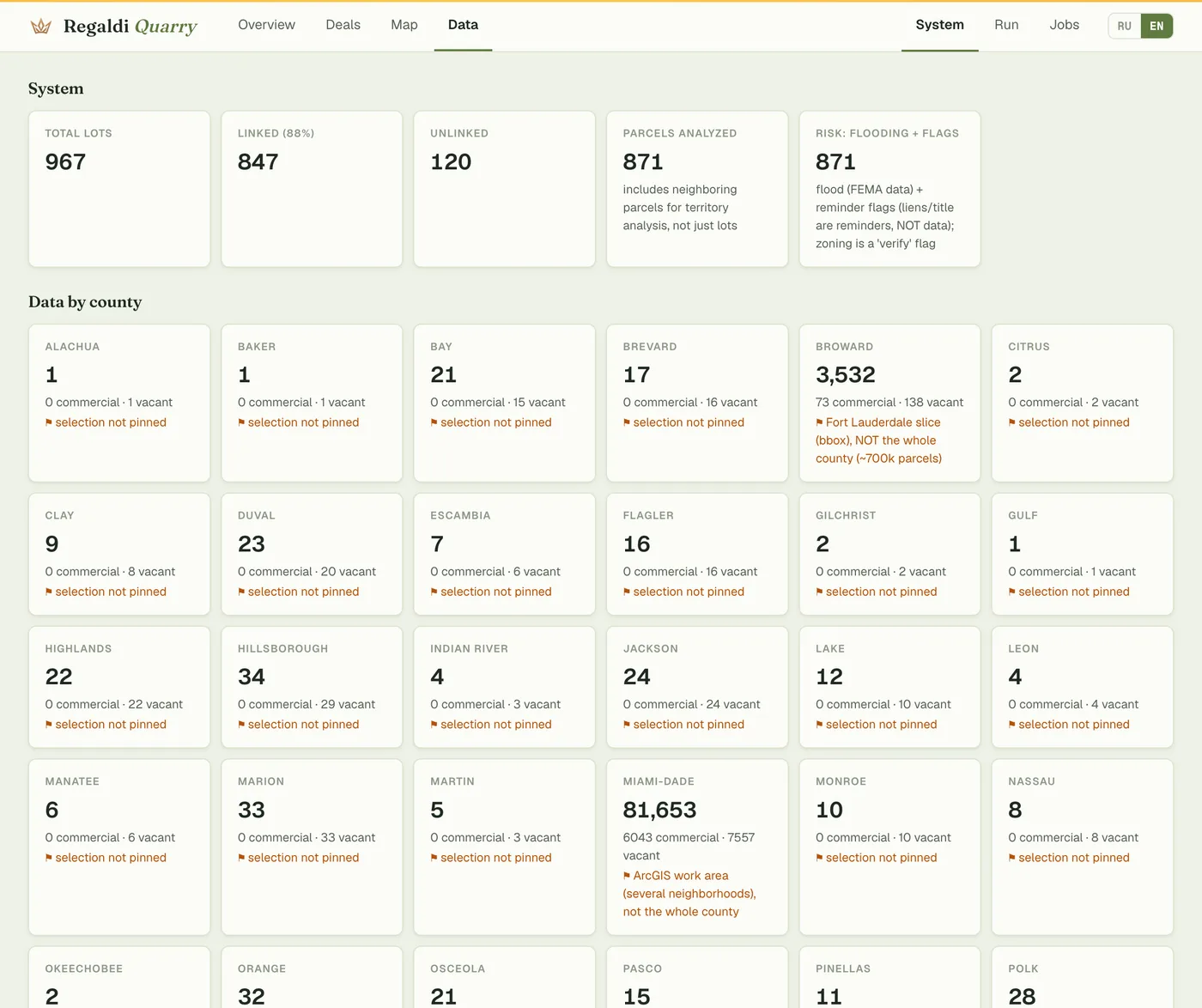
Quarry holds Florida's distressed-property market as a live dataset: the auction calendar across the state, available matches to the statewide parcel cadastre, refreshed on a nightly schedule. These screens show captured examples. Current counts, coverage and source freshness can differ.

  1. 1Scheduled nightly. Collection and analysis are scheduled each night. Source availability, collection failures and publication delays can affect freshness; check the source date before relying on a record. Nightly · scheduled
  2. 2Matched to the parcel cadastre. Lots are tied to the statewide parcel record, so owner, area, use, and assessed value sit under each one. Most are matched; the rest are marked, not guessed. FL statewide cadastre
  3. 3County by county, honest. Coverage is shown per county with the gaps named in place, tens of thousands of parcels held in the worked counties. Per-county coverage
Quarry data-coverage panel: linkage status and parcel counts per Florida county.
02Coverage · forty counties

Forty counties on one map.

Distressed land sells county by county, on as many separate sites. Quarry puts the forty counties it collects on one map, matched lots placed with scenario indicators for review, so the work starts across the state rather than one metro at a time.

  1. 1From the Keys to the panhandle. Lots across forty counties on one canvas, two auction channels, tax-deed and foreclosure, in the same view. 40 counties · 2 channels
  2. 2Eight layers, on demand. Flood, contamination, evacuation, schools, hospitals, fire, police, and city limits, each a toggle along the top. FEMA · FDEP · FDEM · USGS · FDOT
  3. 3Indicators for review. Green, amber and red indicators help prioritise records for investigation. They are scenario signals, not a recommendation to buy or skip a property. Strong · medium · weak
Quarry map of Florida: auction lots across forty counties with risk-layer toggles and a buy/skip legend.
03Risk · up close

Risk and context, laid over the parcel.

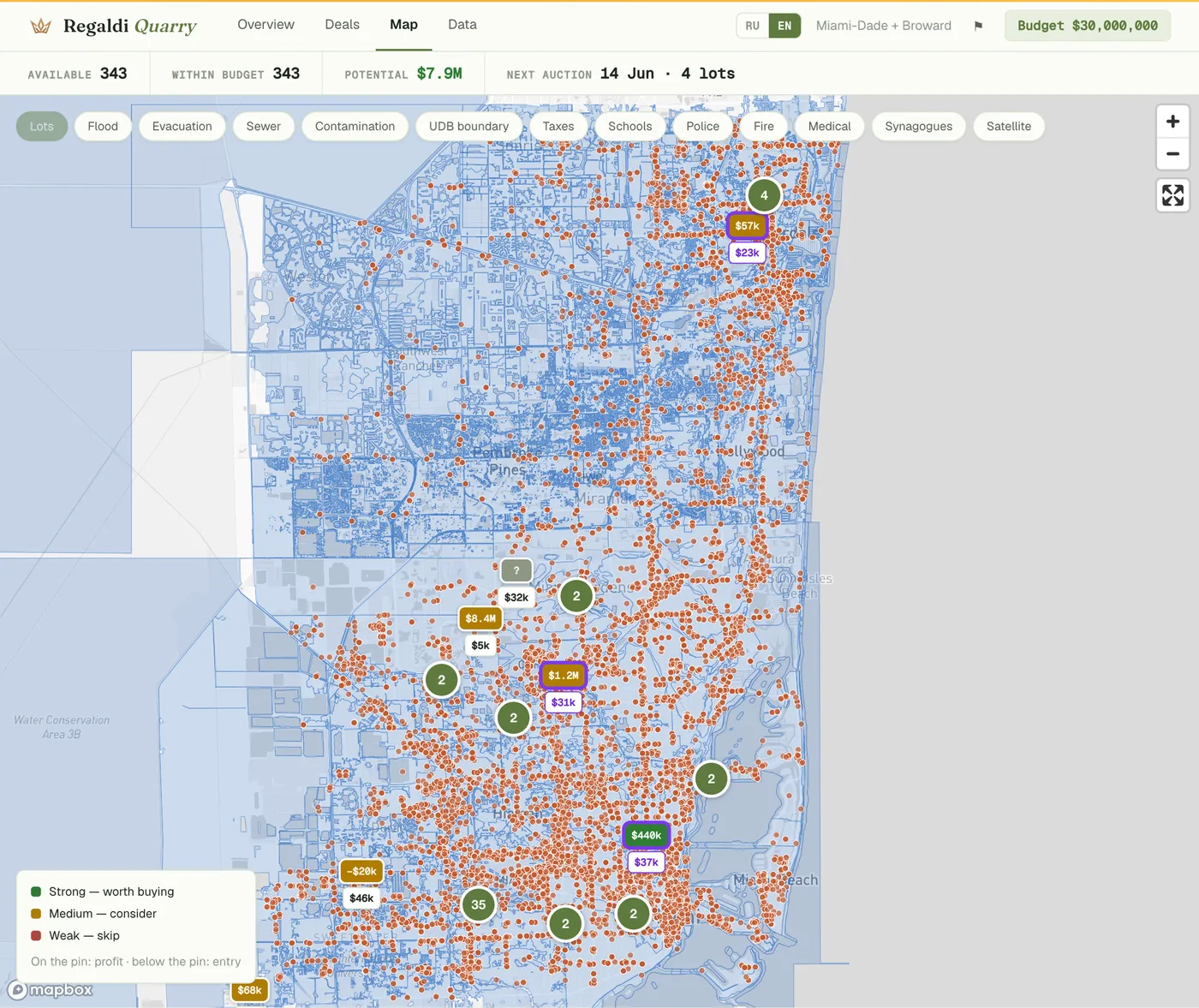
Zoom to a corridor, here Miami to Fort Lauderdale, and the layers tell the story a listing leaves out: the flood plain in blue, contaminated and cleanup sites in orange, the things that quietly cap what land is worth.

  1. 1The flood plain, in blue. FEMA flood zones drawn under every parcel, so a lot in the special flood hazard area is obvious before a site visit. FEMA NFHL
  2. 2Contamination, in orange. Cleanup, petroleum, and brownfield sites from the state environmental record, dotted across the corridor. FDEP · 32k+ sites statewide
  3. 3Read at the parcel. Each lot is scored against the layers within range, so the risk surfaces on its card, not in a separate report. Per-lot flags
Quarry map zoomed to the Miami to Fort Lauderdale corridor with FEMA flood zones and FDEP contamination sites overlaid.
04Decision · the money case

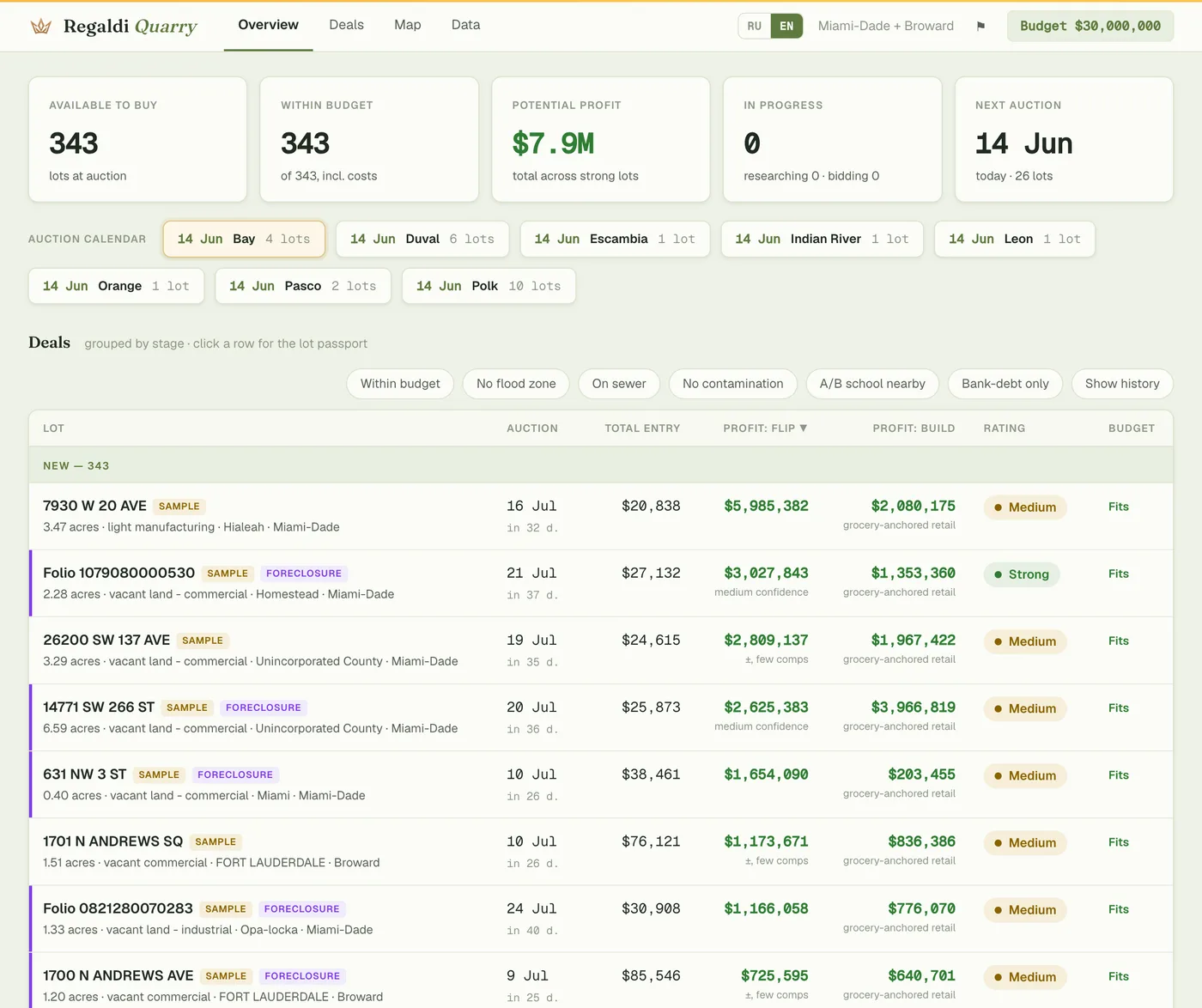
Ranked, with the math on the row.

Where inputs are available, Quarry organises entry-cost, resale and build scenarios. These estimates need independent checking before a decision. The auction calendar shows what sells when, and filters cut the board to what fits.

  1. 1The math is on the row. Total entry, a resale (flip) case from comparable parcels, and a build case where the land supports it, each with its confidence. Thin data is marked, not invented. Entry · flip · build
  2. 2The calendar, by county. What sells, where, and when, collected on a nightly schedule, so the calendar is read in one place rather than county by county. Auction calendar
  3. 3Cut to what fits. Filter to within budget, no flood zone, on sewer, bank-debt only, and the shortlist narrows in a click. Within budget · no flood · …
Quarry deals table: lots ranked with total entry, flip profit, build profit and a plain rating, above an auction calendar by county.
05Decision · one lot, in depth

Drill into one, and the case is made.

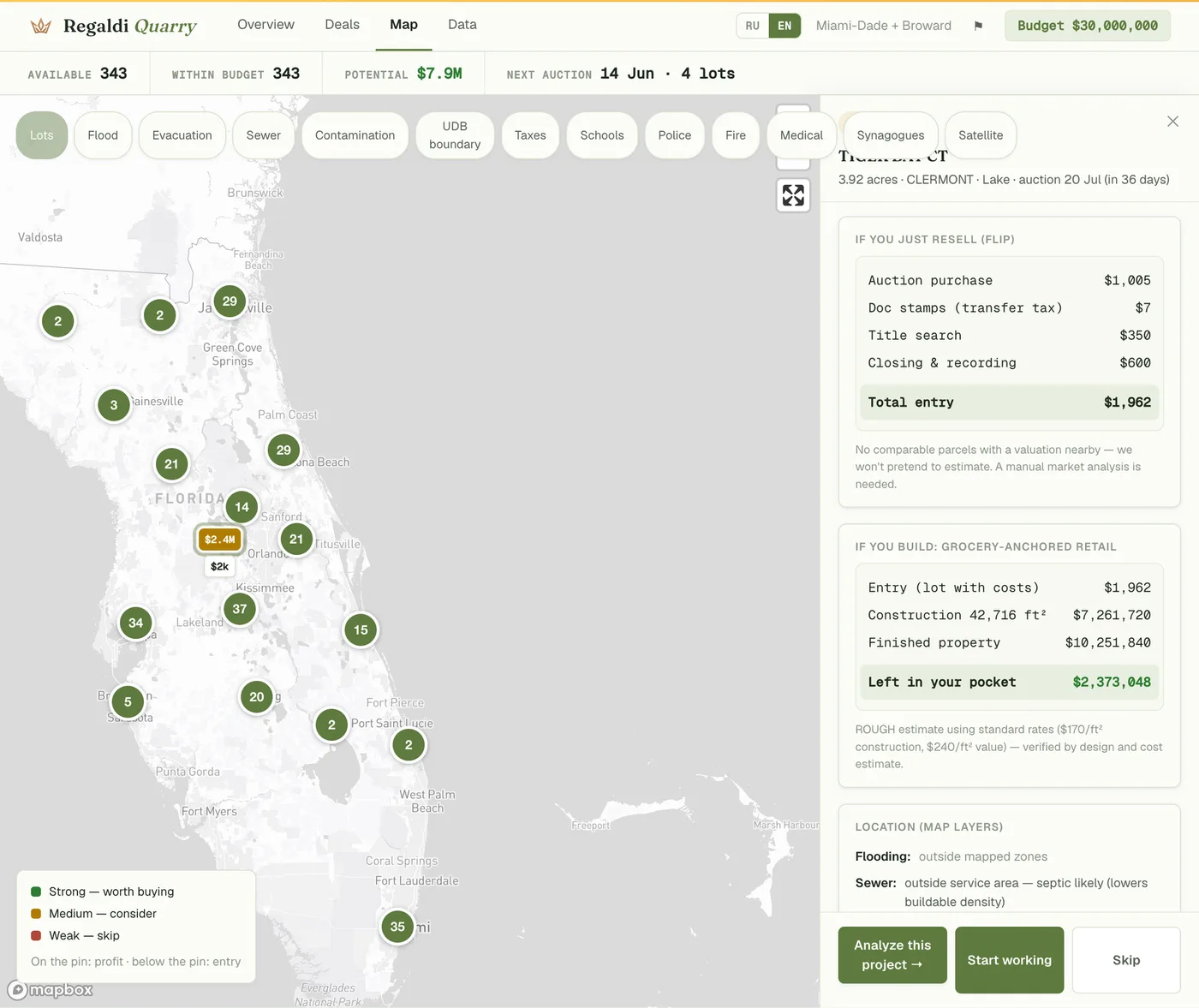
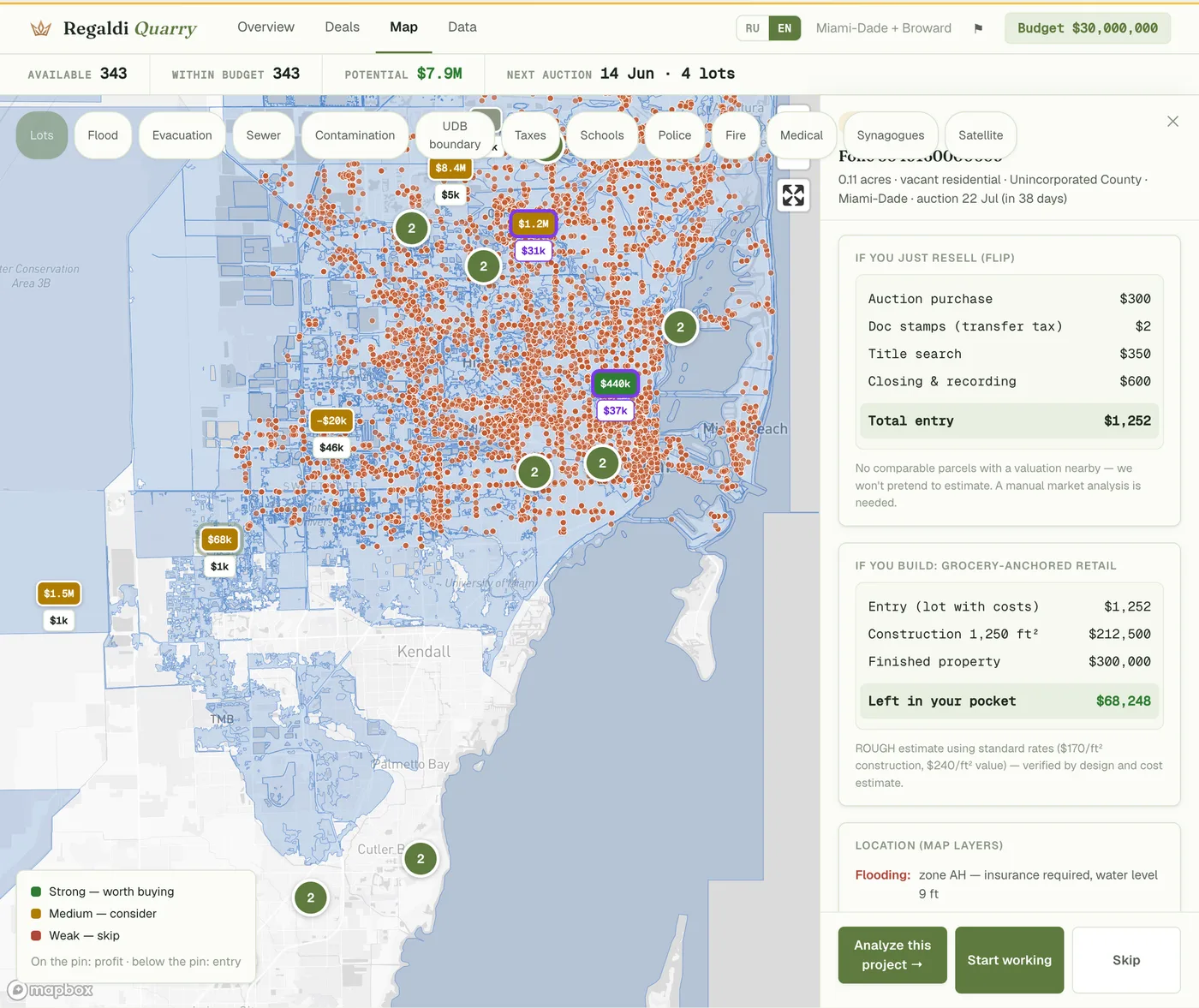
Open a lot and the full case is laid out: the entry, the resale and build math to the dollar, the risk flags read from the layers, and the next step. The links, to the live auction and the county parcel record, sit one click away.

  1. 1The economics, to the dollar. Entry built from the bid and closing costs, a resale case, and a build case with construction cost and finished value, ending in what is left in your pocket. Flip · build · net
  2. 2The risk, in plain words. Flood zone and utility status read straight from the layers, in a sentence, not a code. Flood · sewer flags
  3. 3One click to act. Open the live auction or the county parcel record, or move the lot into your own pipeline. Auction · appraiser · pipeline
Quarry lot passport: flip and build economics, flood and utility flags, and actions, beside the lot on the statewide map.

The instrument is one thing. The desk you work it from is another.

On its own, Quarry is a desk: the parcels, the auctions, the risk, the math. Regaldi Studio, the desktop AI workspace, connects to it through a read-only connection that Regaldi sets up with you. You ask in plain language; Studio reads Quarry and turns the result into a dossier, a letter or a list. The output gathers available records and references for professional review; anything that would send, pay or sign waits for your confirmation.

What comes back · the parcel dossier
01
The parcel and its record

Legal description, the appraiser record, and the auction posture if it is headed to one: which sale, which date, which case number.

02
The recorded chain

Deeds and transfers as the county recorded them, in order, each entry cited to the book and page it lives at in the official records.

03
What sits against it

Mortgages, liens, judgments and lis pendens as published in the county official records, each with its source, for a professional to check against current records.

04
The people behind the owner

Where the owner is an entity: the company, the officers behind it, the related entities and their filings, drawn from the state registry and connected into one picture.

05
The courts

Cases touching the parcel or its parties, in the counties that publish their dockets. Where a county publishes partially, the dossier says so instead of guessing.

06
The ground itself

Flood zone, contamination neighbors, evacuation zones, schools and hospitals: the context that quietly caps what the land is worth.

07
The money case

Entry cost, a resale case, a build case where the land supports one, and a plain verdict, marked low-confidence where the comparables are thin.

Said plainly, before anyone relies on it

The dossier is prepared research with references to the records used and gaps that need review. It is not a title opinion, not a commitment, and no substitute for title insurance: those are licensed work, and they stay with the licensed. Quarry reads what the counties publish. Where a county publishes partially, the dossier says so. Florida only.

A broker

“Everything on this parcel before I take the listing.”

The dossier lands before anyone drives out: the recorded ownership and available filings, with sources and gaps, what is recorded against it, what the auction calendar says, and what the money case looks like. And when the brief runs the other way, find me the owners of parcels like this one, Studio lists them with their records, and you decide whom to write to and what to send.

An attorney

“The parcel, the parties, and everything recorded, with sources I can check.”

A pre-suit evidence packet: the chain, the encumbrances, the entity network behind the owner, the docket history where counties publish it, every line cited to its source. For enforcement work, the same research pointed at what a debtor holds and where judgments already sit. You draw the legal conclusion. The packet is built so you can.

An investor, a builder

“The three lots worth my Saturday.”

The shortlist with the math already run, the risk already on the card, and the dossier ordered on the two you mean to bid on. In Studio the auction calendar stays at hand, the research is pulled when you ask for it, and after the sale you can look again at the ones that did not close.

We do not recommend the pair if
  • You need a title opinion or a commitment of title insurance. That is licensed work, it stays with the licensed, and the dossier does not pretend otherwise. It is the research a professional signs off on, not the signature.
  • You work outside Florida. One state, done properly, is the whole point.
  • You want the raw data as a feed to resell. Access is granted to people who work the parcels, not to people who rewrap the data.
  • You need courthouse-complete certainty in a county that publishes its records partially. The dossier names the gap. It does not fill it with a guess.
  • You want outreach to run on its own. Quarry contacts nobody, and anything Studio would send in your name waits for your confirmation.

One desk, one instrument, one record. The research arrives cited, nothing leaves in your name without your confirmation, and the record of each action stays available for your review.

Order a dossier.

Quarry runs today on Florida tax-deed and foreclosure data from forty counties. Send the parcel or the matter; we confirm what the county publishes, the scope and the price before any work begins.

Quarry in your profession

15 profession pages show where Quarry fits in the work, which processes it carries and which stay with your team. Product access and supported workflows are confirmed before setup.

All professions →

What is Quarry, in one line?

A desk tool for Florida distressed-property auctions: it collects the lots in forty counties, links them to parcels where a match is available, overlays statewide risk layers, runs the money case, and ranks what is worth a closer look.

Is the dossier a title search?

It is a research packet assembled from available public records, with source references and gaps for review. It does not replace a professional title search, title opinion, commitment or insurance policy. Coverage and record matching vary by jurisdiction.

How does Quarry work with Regaldi Studio?

Regaldi Studio, the desktop AI workspace, connects to Quarry through a read-only connection that Regaldi sets up with you. You ask in plain language for parcels, auctions, owners or a docket; Studio reads them from Quarry and turns them into a dossier, a letter or a list. Quarry contacts nobody, and anything Studio would send, pay, sign or delete waits for your confirmation.

Which counties are covered?

Auction collection covers forty of Florida's sixty-seven counties on a nightly schedule. Parcel matching uses the statewide cadastre where a match is available, and the risk layers cover the whole state. The depth of official records and dockets varies county by county, because the counties themselves publish differently. Every dossier names its sources and marks its gaps, so you know what was read and what could not be.

What does it cost?

Quarry research is sold by the order: a parcel brief or a research dossier, and three dossiers can be ordered together for a matter or a shortlist. Each order is scoped in writing before work begins, Florida only. Prices and terms are on the pricing page at regaldi.ai/pricing/. See pricing →

Where does the data come from?

County auction platforms (tax-deed and foreclosure), the Florida statewide cadastre for parcels, FEMA for flood, the Florida Department of Environmental Protection for contamination, and state and federal layers for evacuation zones, schools, hospitals, fire, and police. Screens and counts illustrate captured system output; current coverage must be checked for the requested research.

Does Quarry tell me what to bid?

It shows the math, entry cost, a resale case, a build case, and a plain verdict, with the basis for each. The decision and the bid remain yours. Where comparable data is thin, Quarry marks the estimate as low-confidence rather than presenting a false precision.

How does this relate to Regaldi the pharmaceutical practice?

Same hands, same discipline, different field. Regaldi builds systems of record for regulated pharmaceutical operations; Quarry applies the same method, turning messy public data into one structure a person can decide from, to land. It is sold on its own, separate from the regulated product line.
Say where you work. Ita reads it before she says hello.

AI assistant Ita is software. A principal reads the transcript afterwards.